Buying a junior padel racket sounds straightforward — but get the size or weight wrong and your child will either struggle to swing it or develop bad habits compensating for a racket that's too heavy or too long. The right racket at the right age makes the game feel easy. The wrong one makes it feel like hard work. Wondering when to start? Read our guide on what age kids can start padel before you shop.
This guide gives you the exact numbers: length in cm, weight in grams, and shape recommendation for every age group. No fluff, no guessing.
Mini Replicas vs Real Junior Rackets
There's an important distinction that confuses a lot of buyers. Mini padel replicas — the kind we review on this site — are 15–25cm collectibles designed as gifts, desk displays, or keepsakes. They are not functional sports equipment. They're the padel equivalent of a toy car: it looks like the real thing, but you can't drive it.
Junior padel rackets are real, functional rackets sized and weighted for children. In practice they come in two forms: shorter kids' rackets of around 42.5–43cm (like the HEAD Monster Kids or Babolat Alioth Mini), and full-length junior rackets at the regulation 45.5cm that are simply built lighter. The real difference from an adult racket is weight — junior rackets run roughly 230–345g against 350–390g for adults — the very lightest, like the 230g Teddy Padel, are purpose-built coaching rackets for ages 3–6.
Both have their place — a mini replica is a brilliant gift for any age, while a junior racket is what you buy when a child actually wants to play. This guide covers the junior racket side. For mini replicas, see our full mini racket review. For the full three-way comparison — replica vs toy vs junior — see our guide to the difference.
The Junior Padel Racket Size Guide
Here's the reference table, built from the junior rackets actually on sale (specs and prices checked at PDHSports, July 2026). One thing that surprises most parents: junior padel rackets don't shrink much with age. Unlike tennis, the market runs from ~43cm kids' models straight to the regulation 45.5cm length — weight is the number that matters. If your child is tall or strong for their age, size up a weight band, not a length.
| Age | Typical height | Racket Length | Weight | Recommended Shape | Notes |
|---|---|---|---|---|---|
| 3–6 years | 95–115 cm | ~43 cm | 230–300 g | Round | Teddy Padel — 230–240g, £49.99 (Express Padel; stock patchy) · Kuikma PR 100 — 265g (Decathlon) · Bullpadel Indiga Boy 26 — 280g, £53.99 · HEAD Monster Kids — 300g, 43cm, £47.99 |
| 6–8 years | 115–130 cm | 42.5–43 cm | 265–300 g | Round | Kuikma PR 100 — 265g (Decathlon) · Babolat Alioth Mini Junior — 290g, 42.5cm, £59.50 |
| 8–10 years | 128–142 cm | 43–45.5 cm | 300–320 g | Round | Babolat Alioth Junior — 320g, 45.5cm, £76.50 · Wilson Blade Junior V4 — 300g, 43cm, £89 · Kuikma PR 190 Light — 310g (Decathlon) |
| 10–12 years | 140–155 cm | 45.5 cm | 310–345 g | Teardrop | HEAD Speed Junior — 320g, £76.50 · Babolat Alioth Pro — 330g, 45.5cm, £103.99 · Kuikma PR 560 Light — 330g (Decathlon) |
| 12+ years | 155 cm+ | 45.5 cm (regulation max) | 350 g+ | Any | Transition to a light adult racket |
Height bands are typical for each age. If your child is tall or strong for their age, use height rather than age to pick the band — and size up a weight band, not a length.
🎯 Junior Racket Size Finder
Pick the child's age — we'll give you the right spec and rackets we've verified on sale.
Racket recommendations based on specs and prices verified at PDHSports, Express Padel and Decathlon, August 2026.
First Steps on Court
At this age, padel is about fun and movement, not technique. The racket should be the lightest real junior racket you can find — in practice that means 230–300g. The lightest real racket we’ve verified on sale is the Teddy Padel range at 230–240g (£49.99 at Express Padel, the official UK distributor — though stock comes and goes, with several characters on backorder as of August 2026): a genuine round, mid-balanced coaching racket designed for ages 3–6, not a toy. The most reliably stocked ultra-light option is Decathlon’s Kuikma PR 100 at 265g — one-piece EVA foam core, fibreglass surface, balanced towards the handle. Below about 200g you’re into toy and beach-bat territory: fine for the garden, not built for court play. Foam or EVA cores make it easy to get the ball moving without needing adult power. Round shapes are strongly recommended: they're the most forgiving for beginners with unpredictable swings.
The grip should fit comfortably in a small hand — look for grip sizes 0 or 1. Don't worry about performance at this age. Getting them on court and having fun is the entire goal.
Starting to Play Properly
By 5–8, kids can start learning real padel movements — proper grips, basic positioning, and rally consistency. The racket can be a touch longer and heavier, but still keep it in the lightweight range. A round shape remains the best choice: at this age, consistency matters far more than power, and the large central sweet spot of a round racket rewards good-ish contact with a reliable shot.
Towards age 7–8, you can start introducing teardrop shapes if the child is playing consistently and wants a bit more variety in their game. But never rush it — round first.
Getting Serious
At 8–10, most children playing regularly are ready to transition to a teardrop shape. Their technique is developing, they have a more consistent swing path, and they can start to appreciate the balance between power and control that a teardrop offers. The sweet spot is still large but slightly higher up the frame — rewarding better positioning and timing.
Keep the core material soft (EVA foam) — don't be tempted by harder, more "advanced" cores. At this age, a soft core generates more power with less effort and is easier on developing joints and wrists.
Almost Adult
By 10–12, kids are approaching adult racket territory. Some taller or more advanced 12-year-olds can even start using a full adult racket if their technique is solid and they have the strength to control it. The transition rackets in this age group bridge junior and adult specs — slightly lighter than a full adult racket but with the same length and shape options.
At this age, ask the child what shape they prefer. They'll have opinions, and involving them in the choice makes them more invested in training. Teardrop is still the safest all-rounder, but if they're clearly a power player, a diamond shape can be explored.
Which Shape? Round vs Teardrop for Kids
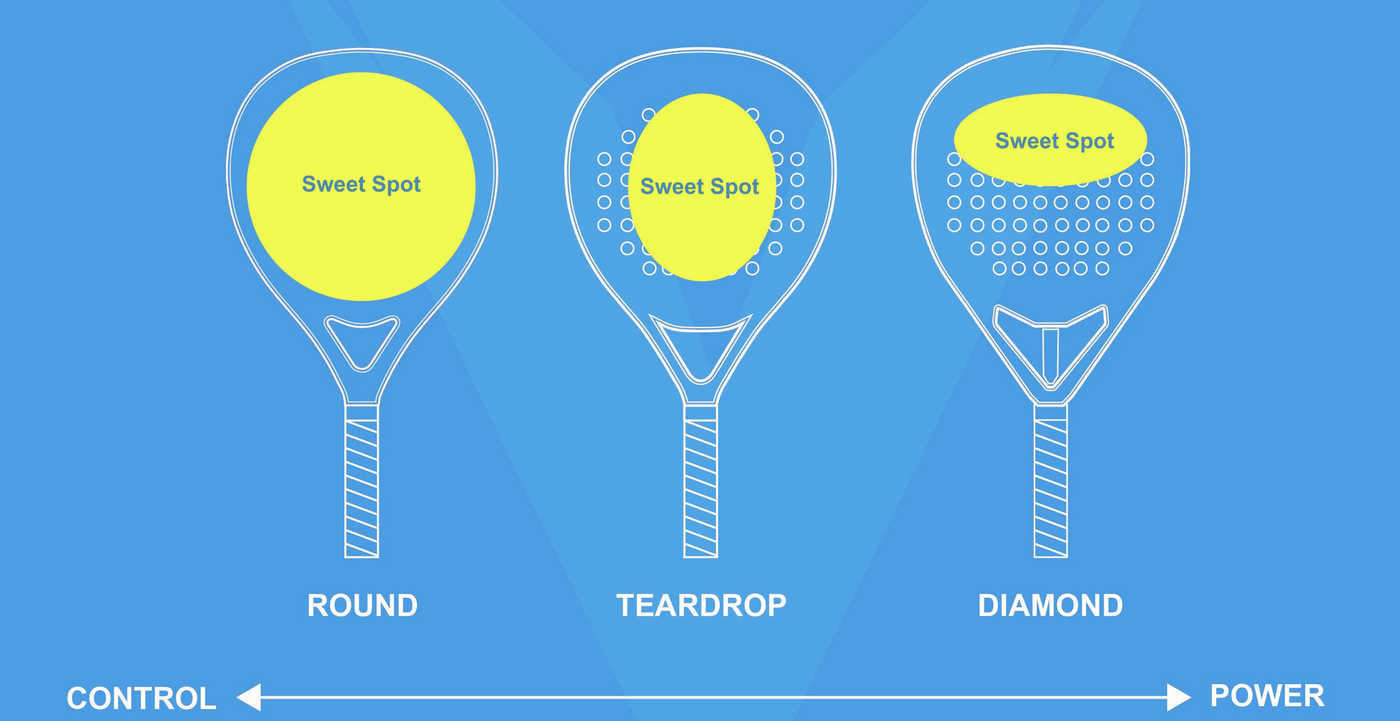
Forget diamond shapes for children under 12. Diamond rackets concentrate the sweet spot at the very top of the frame — they generate maximum power but require a very consistent swing path to work well. Even adult beginners struggle with diamonds. For juniors, the choice is round or teardrop.
Round: The Right Choice for Most Juniors
A round-shaped racket has its sweet spot in the centre of the frame — the largest, most forgiving hitting zone possible. This means off-centre contacts still produce a decent shot. For a child with a developing swing, this is invaluable. They don't need to be perfect to get a good result.
Teardrop: For Ages 7+ With Some Technique
Teardrop shapes move the sweet spot slightly higher, offering a balance between the forgiving centre of a round and the power of a diamond. For children who have been playing for a couple of years and have decent technique, a teardrop is the natural progression. It rewards slightly better positioning and opens up more shot variety.
Best Junior Padel Racket Brands
HEAD has the most comprehensive junior range — they make purpose-designed junior versions of their Radical, Extreme, Speed, and Coello lines at multiple sizes. If you're unsure, HEAD junior rackets are the safest bet across all age groups.
Babolat makes excellent junior rackets with a particular focus on comfort and ease of use. Their Babolat Alioth Junior is a popular entry-level choice for ages 5–8.
Bullpadel brings their quality construction to junior rackets. Their Bullpadel Vertex Junior range is well-regarded for durability — important for kids who will inevitably hit the frame against the glass once or twice.
NOX is a strong option for the 8–12 age group, offering junior versions of their popular adult lines with appropriate specs and good value. Browse the full junior racket range at PDHSports.
Teddy Padel is a specialist you won’t find in most roundups: character-branded rackets (Tim Bear, Molly Bear, Amanda Panda and friends) built for ages 3–6 at 230–240g — the lightest real padel rackets we’ve verified anywhere. Round shape, mid balance, sold in the UK through Express Padel at £49.99 with a branded cover included. The catch: stock is inconsistent, with models regularly on backorder.
Kuikma is Decathlon’s padel brand and the value play for juniors. The PR 100 (265g, ages 5–8) uses a one-piece Full EVA foam core and typically costs well under half the price of branded equivalents. The PR 190 Light (310g, 8–11) and the PR Evolution range (~320–330g, 9–12+) cover the older bands. If budget matters more than the badge, start at Decathlon.
Common Buying Mistakes
Buying too heavy
The most common mistake by far. Parents assume a heavier racket means more power, but for children it means fatigue, bad habits, and potential injury to developing joints. Always go lighter than you think you need. A child can generate more effective power with a light racket they can swing fast than a heavy racket they can barely control.
Buying too long
A racket that's too long will force the child to compensate with their body position. The rule of thumb: if the child can't comfortably hold the racket at their side and have the tip clear the ground by a few centimetres, it's too long.
Buying adult shape too early
Diamond and hard-core teardrop rackets are for adults with developed technique and strength. Putting a child on a diamond-shaped racket before age 10–12 almost always hinders development. Start with round, progress to teardrop, and don't rush.
Buying for growth
"They'll grow into it" is well-intentioned but counterproductive with sports rackets. Using a racket that's too big or heavy for a child for months at a time will create muscle imbalances and bad technique that takes years to undo. Buy for now, not for two years from now.
Ignoring grip size
Adult grip sizes are too large for most children under 10. Look for rackets with grip size 0 or 1 for young juniors. A grip that's too thick prevents proper wrist movement and makes technique harder to develop.
Frequently Asked Questions
What size padel racket does a 5-year-old need?
A 5–6 year old needs the lightest real junior racket available — around 230–300g and 42.5–43cm long (e.g. Teddy Padel at 230–240g, Kuikma PR 100 at 265g, Bullpadel Indiga Boy 26 at 280g, or Babolat Alioth Mini at 290g). Junior padel rackets don't come shorter than this — anything smaller is a toy or a display replica. Round shape, grip size 0 or 1.
What age can kids start playing padel?
Children can start basic padel movements from around age 3–4 with a soft foam racket. Structured court play typically begins around age 5–6, when children have enough coordination to follow basic game rules and rally consistently.
What is the difference between a junior and adult padel racket?
Mainly weight. Junior rackets run 230–345g against 350–390g for adults, with softer cores that generate power without adult strength. Length differs less than most parents expect: kids' models are ~43cm and many junior rackets are already the regulation 45.5cm — the maximum any padel racket (adult or junior) is allowed to be. The grip circumference is also smaller.
Which brands make the best junior padel rackets?
HEAD, Babolat, Bullpadel, and NOX are the most respected brands for junior rackets. All four make purpose-designed junior ranges with appropriate sizing, weight, and materials for different age groups.
What is the lightest junior padel racket?
The lightest real junior padel racket on sale is the Teddy Padel at 230–240g, designed for ages 3–6 and sold in the UK via Express Padel (£49.99). The lightest widely stocked option is Decathlon’s Kuikma PR 100 at 265g. From the major racket brands, the floor is the Bullpadel Indiga Boy 26 at 280g. Anything sold as a padel racket below ~200g is a toy or beach bat, not court equipment.
How often should I replace my child's padel racket?
Plan to replace a junior racket every 1–2 years, as children grow quickly. Buy at the larger end of the recommended size range to get more life from each racket — but never so large that it affects their technique or enjoyment.
Looking for a Mini Padel Gift Instead?
Not ready for a real racket yet? Our mini replica guide covers every collectible and baby gift option.
See the Mini Racket Guide →Last updated: August 2026. Model specs, prices, and availability verified at PDHSports, Express Padel, and Decathlon in August 2026. Specifications may vary slightly by brand and model — always check the manufacturer's own size guide for the specific racket you're considering.